JANGAR! Slaves of the Mind Mage is the first installment of a six-part eBook series by L.D. Whitney, which will be compiled into a paperback upon completion. It’s fun and momentous, and boasts some of the cleanest prose I’ve seen in an indie publication.
Before even jumping into the story, this release strategy is bloody brilliant. Though I love seeing novelettes published in print, eBooks have become the new pulp paperback. Compiling a complete collection is a frugal and effective way to meet print culture halfway and a slow drip of excellent digital content is surefire way to generate hype for the book. Indie authors, take some notes!
Slaves of the Mind Mage introduces the reader to Jangar, a jungle-roving barbarian with a straight-forward worldview, bulging thews, and an iron-clad will. The author lists Lin Carter’s Thongor (classic) and Steve Dilks’s Gunthar (modern) as core inspirations. I’ve never read Dilks—though I am acquainted with his work—so I can’t attest to the similarities there; but I am currently half-way through Thongor and the Wizard of Lemuria thanks to JANGAR! (review coming soon).
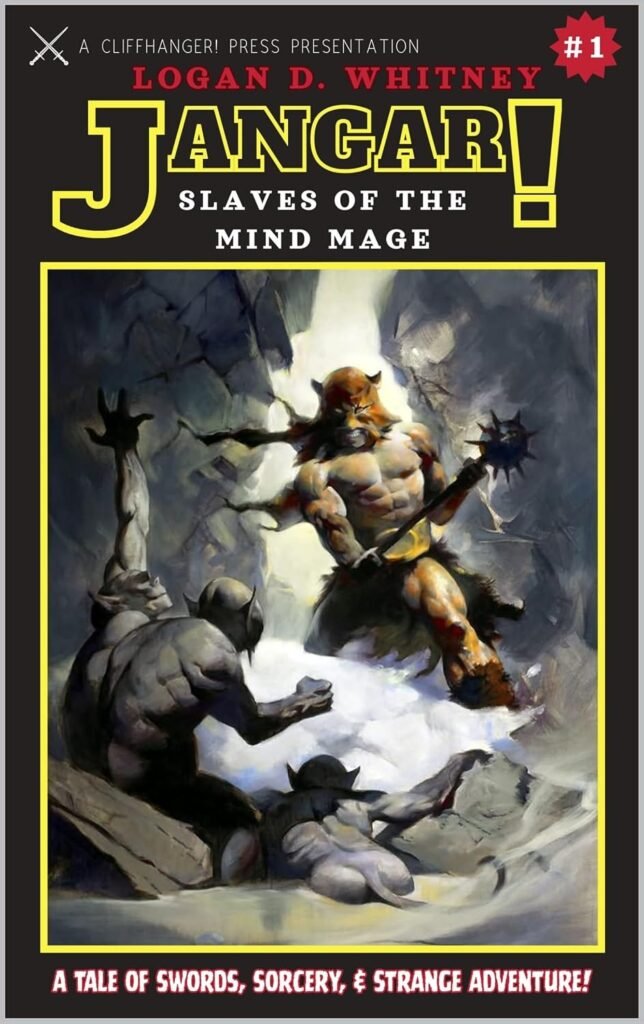
While I can certainly see Carter’s roots running through Whitney’s writing, Whitney takes the concept of the jungle warrior and grounds him in historical realism. Thongor is over the top and ridiculous (not a criticism, that’s the point of Thongor). Jangar’s encounters in the jungle are weighty and tense; and bloody exciting when he inevitably kicks some ass.
Pulp really thrives in the short form, and Whitney is clearly no stranger to starting off a short story with a bang. Note the repetition in his opening paragraph, the alliteration, linking the drums with the wild jungle and Jangar’s heart. Jangar is one with the jungle, and all its habitants. Beautiful, grotesque, deadly.
“JUNGLE DRUMS THUNDERED in time with Jangar’s beating heart. The primeval forest, typically teeming with all manner of life, had yielded its roars and caterwauls to the relentless rhythm of those terrible drums. Jangar, reared in these wildlands by wild things, knew well the drumbeat”
Whitney 1, Opening lines.
Momentum, Teamwork, and POV
The opening of this tale finds Jangar searching for his unnamed companion. He encounters a group of reptilian humanoids called Ur-Men in the process of sacrificing a woman in tribute to their mega-dino-god, Thok, by blowing a sacred horn to summon the hungry beast.
The woman on the pyre is Yala, and she’s no damsel-in-distress, despite her initial circumstances. She’s fleeing a life of sedantry and complacency, crossing through the jungle on her way out of her home city when she and her traveling party were ambushed by Ur-men.
Chapter 2 shifts away from Jangar to Yala’s POV, where she witnesses the warrior’s prowess but also takes advantage of her turn of fate by snatching the dropped god-summoning horn in the chaos—a literary bell Whitney will ring to great effect throughout the tale.
The story continues alternating between Jangar’s and Yala’s POVs. They have vastly different perspectives, embodying the classic Howardian dichotomy of primal vs. civilized. The author utilizes this classic theme to lace a subtle nuance through the entire narrative.
Where Jangar stirs my blood, Yala kept the pages turning. She’s vulnerable, which adds tension to the scenes in which she’s alone, but she’s also clever and has good instincts. She helps Jangar as much he helps her.
Every change of POV upped the ante, progressed complications, and generated momentum.
In Sum
Whitney has crafted what appears to be a simple tale on the surface, a framework that’s been iterated upon a thousand times over—but did so in a way that only he could. Jangar carries echoes of Thongor, but the similarity between the two is more akin to the resemblance of a young boy and the grown man he grew into.
Jangar is the natural evolution of the Pulp Fantasy jungle warrior, a maturation of a fun concept that demands proper attention. The technique, the narrative content, and even the publishing strategy takes the sturdy bones of the classics and arranges them into something altogether stronger.
I don’t have much to say about this one by way of criticism beyond wishing I had seen more of Jangar’s wild companion… I suppose I’ll just have to read the next one. Oh darn.
For $2 on Kindle, this tale is 100% worth your time if you love classic jungle-delving Sword & Sorcery.
Leave a Reply