Throughout my exploration of essential classic Sword & Sorcery, I have been consistently disappointed with many authors’ ability to rival R.E. Howard. I’ve heard this is because Howard wrote with a consistent central thesis that many of his followers lacked, or failed to clearly define. I also have hyper-specific taste (as do most readers) and Howard’s original works just happen to scratch the S&S itch that gnaws at my side, where many others don’t.
It’s not that non-Howard classics are bad, or unenjoyable, but I do find myself picking them apart in way I don’t often do with Howard (see my review of Michael Moorcock’s The Fortress of the Pearl for more elaborate thoughts on that subject).
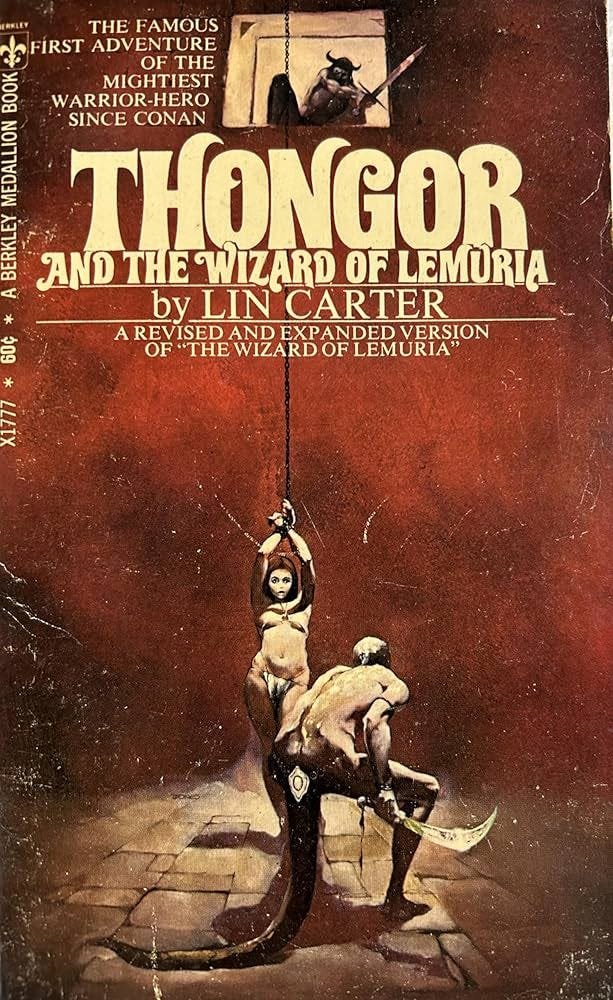
This is not the case with Lin Carter’s Thongor and the Wizard of Lemuria; and my incoming praise isn’t because Thongor is a literary masterwork or even because it’s compelling or original (it is the former, not the latter, but not for the reasons you’d assume).
Thongor stands out because he’s cool as hell.
I was drawn to Thongor for two reasons. One being that it’s an inspiration behind JANGAR!, an excellent recent addition to the jungle warrior mythos. The second being a friend’s claim that my own S&S follows Carter’s footsteps rather closely. I found that odd because I had only read Carter’s “People of the Dragon” short stories (which, in fairness, did directly inspire my Great Cave Stories like “The Evil Eye”), but I had never dived into his most famous work.
Thongor and the Wizard of Lemuria is a genuinely relaxing read. You can be drained and exhausted and still squeeze pages and pages of high octane, over-the-top middle school action and feel good doing it.
It’s fun and purposely stupid to a degree that most authors are afraid to embody, yet Carter maintains a masterful standard of craft and technique in the prose. This, in my opinion, is a rare and coveted combination.
Many people are highly critical of this book, even among avid S&S readers. I think this is unfair; Thongor is GOLD.
For more Fantasy reviews and original fiction that puts my money where my mouth is:
The Over-Powered Hero at its Best
Both in other book reviews and within The Arcanist’s submissions, I see readers criticizing the notion of power fantasy. I do understand this stance to a degree but I disagree with it’s universal application. Sometimes you just want to relax and read a simple tale where a hero does hero stuff… and that’s okay.
In the beginning sequence, Thongor hijacks a magical aircraft that the text specifically notes is a one-of-a-kind and has stood unmoving for years because it’s so complicated that no one has ever figured out how to pilot it. To escape a city crawling with guards who want to cut his throat, Thongor simply figures it out.
Why? Because the airship is to become the hub of the whole plot. Also it’s cool. Don’t think too hard about it. Carter establishes immediately that this is a not a story that requires believability.
Where Thongor lacks in significant challenges and risk, he excels in the rule of cool. His over-the-top performances of heroism generates the acceleration that’s neglected by the lack of proper stakes.
“This is how a man fights, Sark of Tsargol. Now let us see how a man dies!”
And he flung the sword glittering through the air. The paralyzed throng watched as the blade completed its sparkling flight— and quenched its brightness in the breast of Drugunda Thal, last Sark of the Royal House of Thal.
Carter, Chapter 10
This passage is the best example of Carter’s perfect balance of showmanship and craft. Note the visual motif in glittering, sparkling, brightness and how it interplays with the personification of Thongor’s sword in quenched its brightness. There has been no cooler description of a ridiculous sword throwing scene. Prove me wrong.
Power-fantasy works with two supporting pillars:
- The reader wants to relax and have fun, and the writer understands this.
- The hero faces challenges outside of combat.
There are only so many problems that steel can solve. You can bring a .44 Revolver camping just in case you encounter an aggressive grizzly—but what good is that big ass gun when you can’t start a fire and its pouring rain?
In my first book, Ashen Rider, Cain is similarly unchallenged by violent encounters. At one point, he bullies an Earl of Hell as a side tangent on his way elsewhere. Yet Cain is the weakest willed bastard in that whole tale, despite his unstoppable fighting prowess. This isn’t to say that Thongor is weak-willed—far from it!—but he is not without his weaknesses.
Thongor the Outsider
Thongor is the very picture of a the outsider S&S archetype. His presence in nearly every situation brings out the worst in people who wish to suppress him or remove him entirely.
The opening of the novel shows Thongor in a one-sided disagreement with an irate officer of his mercenary company. Despite several attempts to take the high ground and deescalate the situation, the officer continuously attempts to assert his dominance by several wily, underhanded tactics, which Thongor eventually answers with a fatal thrust of his trusty broadsword.
This obviously lands him in jail (where we’ll see Thongor many more times before this short book is over), which sets the whole world-ending plot in motion.
Pissing people off and subsequently getting arrested is a bit of a tired motif in Thongor, and is perhaps the biggest weakness of the whole tale. It’s dope the first time, intriguing the second time, but gets real tired, real quick on the third and fourth times.
Even in the final stroke of the plot, Carter generates some genuine tension by sending Thongor over the edge of the airship (which is a great consequence for an overused boon, I must say) to remove him from his companion’s final confrontation with the Dragon Kings. He lands in an aerial dino’s nest and battles a hatchling with a sharpened thigh bone to escape. Very cool and fun—but it’s still a bloody prison sequence with different paint.
This leads me to Thongor’s companions. Sharajsha, the Magician of Mommur is a powerful wizard who acts as a mentor, quest-giver, and powerful companion who can solve problems that Thongor cannot. He is, however, easily taken out of the equation since his magic requires him to press together his hands together to join two magic rings.
Sharajsha is fun deviation from the evil sorcerer of S&S villainy. He’s kind and magnanimous and well humored. Thongor and this wizard find quick friendship (which does remind me of my own magnanimous sorcerer, Phrygian Black, I am beginning to fear readers might think I’ve been reading Thongor all along!)
Then there’s the disgraced warrior prince, Karm Karvus of Tsargol and the exiled Princess Sumia of Patanga. Both characters are equally unmatched to Thongor’s prowess and rely on him heavily. It seems they’re placed to give Thongor something to worry about, since his own life is never a worry.
Karm acts as an adopted brother; Sumia is a love interest. But really, these characters are meant to serve a singular purpose: to give Thongor a community in which he is not outcasted from. These characters respect and empower Thongor, and in return Thongor repeatedly saves them from certain doom.
What I appreciate about this dynamic is that neither of these helpless nobles seem particularly helpless—it’s just that Thongor is unstoppable. A nice mirror they all share is that they are all equally ousted from society and require each other in order to enjoy acceptance.
“Thongor is just a Clonan”
This is a common criticism I see on Thongor reviews. This book is no stranger to the 2-star review from avid S&S fans because he’s just “stupid Conan.” Does it hold water?
No, it doesn’t. Thongor is not a Conan clone.
If we called every mercenary northman barbarian in Fantasy a Conan clone, nearly every Fantasy author would be guilty (Bloody Nine, anyone?) Just as not every handsome, rugged wanderer who is secretly a prophesied hero is not a carbon copy of Aragorn, not every barbarian is a Clonan.
But I’ve come with evidence to support my claims. Hear me out.
One of R.E. Howard’s intentions with Conan the Cimmerian was to tell the story of man who plays many roles. Where many adventure and pulp tales of the time told stories of characters who did one thing (Detective, Treasure Hunter, Pirate, etc.); Conan is depicted serving a different role in nearly every tale.
Sometimes he is a mercenary captain, sometimes a thief, sometimes a king, so forth. All of these tales are strung together by a common theme: civilization is corrupt and decadent, while living off the land is free and pure. There’s obviously more to this, but this is an article about Thongor, not about the inner-workings of Conan.
Conan stories are rather literary in their composition, considering Conan is the grandfather of Pulp Fantasy. He is thoughtful, flawed, and often pushed to the edge. Conan’s story was one that Howard took seriously.
But Carter takes an entirely different approach with Thongor. He doesn’t take the story seriously at all, even if he does take writing prose very seriously.
Carter was one of two editors responsible for simultaneous reviving/bastardizing the original Conan stories (depending on whom you ask), so I think his original fiction is unfairly compared to Conan as a result.
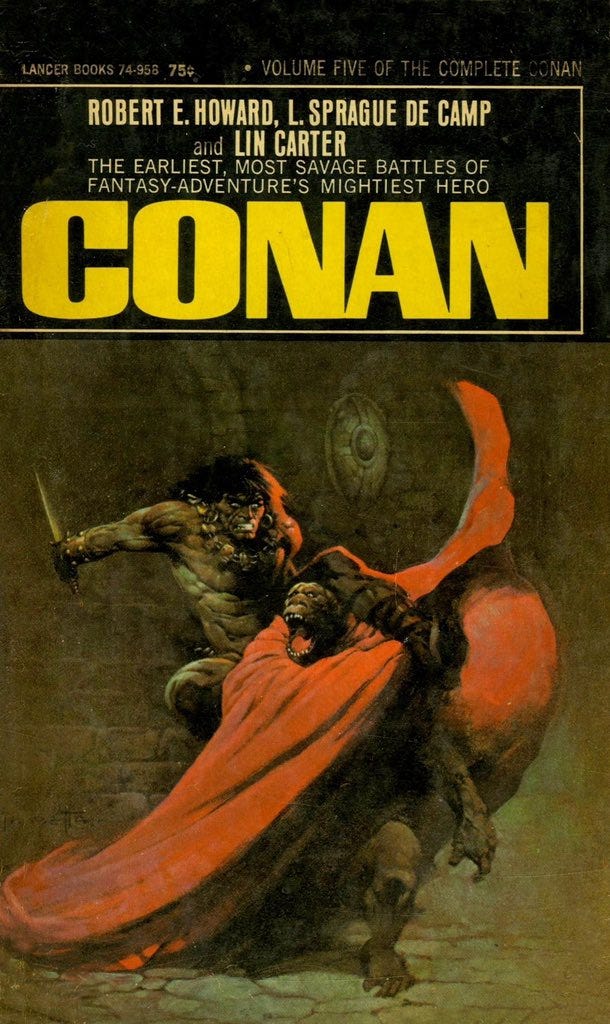
Carter’s Thongor is similar to Howard’s Conan by way of a barely-recognizable ancient Earth setting and the use of a primal northman as a main-character. That’s it.
Thongor (as he appears in Wizard of Lemuria) mixes up the formula by simplifying it. He serves one role—he is an unstoppable hero and he’s happy to serve that purpose. Thongor only has giant mirths (and none of Conan’s melancholies). He is not mercenary in his intentions once he is given a higher purpose, where Conan is usually driven by a job or a duty. Thongor is well-spoken and merciful; Conan is well-spoken and wrathful.
It seems like I’m splitting hairs, but minute details like this are the building blocks of iterating on archetypes. Both Thongor and Conan are similar mythic barbarian heroes according to modern fantastic myth (being collective myth built on recent stories we understand are fictional). We can say that Odysseus and Hercules are copies of Achilles because they serve similar roles in their stories, but no one would deny their unique identities.
Classical myth is just Sword & Sorcery from antiquity; its age being why we respect their validity more than we do Pulp Fantasy. Fight me.
There’s also the setting of Lemuria, which is at once futuristic and Jurassic, straddling the line of High Fantasy in a way the Hyborean Age never comes close to. I may have to write about more about that in another review, as this one has gone on long enough.
In Sum
Thongor is fun and stupid and that’s the point. Yet Carter penned this stupid work of silly fiction with serious skills and technique that makes Thongor a fun romp through an interesting world that respects your time.
You can read Thongor and the Wizard of Lemuria in snippets or read it deeply, and you don’t need to feel bad for checking out a bit while your tired mind drifts off.
Really, it comes down to this: Thongor is cool and you should read it.
Leave a Reply