As part of my delve into Sword & Sorcery, I have opted to go wide with the classics. I’ve read the essentials and I’ve been surprised about which authors I’m enjoying and which I struggle with.
R.E. Howard, is easily top tier, and not just because he’s All-Father of S&S. His prose, world-building, and storytelling reminds me of my favorite author, Steven Erikson, who is (unsurprisingly) influenced by Howard. Similarly, I’ve gravitated towards Lin Carter and his “People of the Dragon” stories, which I work to spiritually success with my own Great Cave stories.
I say I’m surprised by the authors I’ve struggled with, because they are the ones who (on paper) should appeal to me most. C.L. Moore’s Jirel tales are visceral, dark, and dreamy; but I find myself drifting away because of it. Leiber’s habit toward triple repetitions is perhaps one too many, even for my love of repetition. He can be too free with his prose, leading to a strange reading experience like the section in “The Snow Women” where he briefly switches to stage play dialogue between Fafhrd and Mara.
And then there’s Michael Moorcock and the ever-so-loved Elric. Oh Elric, how I thought you might be my favorite, with your dark, soul-eating sword (Dragnipur is totally NOT just Stormbringer, by-the-by), and your great melancholies and grim introspection.
By Crom, this should have been the one!
The Struggles
This isn’t to say that I don’t enjoy the aforementioned tales. I do—enough to keep reading and keep trying with them all. But they’re far from what I expected. And what did I expect? Reasonable question. I’m not quite sure, If I’m honest.
However, as I make my way through SAGA Press’s Elric of Melniboné reprint anthology, I’ve formulated some thoughts about Moorcock’s masterworks. After I read the titular origin story of the albino emperor, I was thrilled by the strangeness and huge scope, but disappointed by rather shallow prose.
Not bad prose. Just not as deep nor up-close as I like to see.
The Fortress of the Pearl improves upon this for sure, but suffers from middle-book slog. Again, I love the idea of Elric’s mythic journey through the dream realms, but it quickly became a checklist or various archetypal dream scenarios.
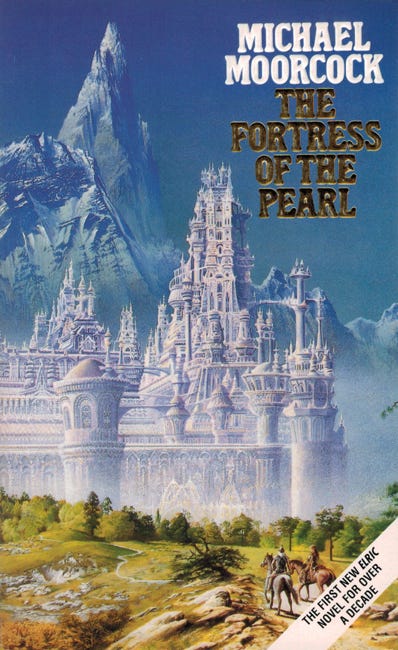
I was completely taken out of the tale when Elric hooked up with Oone the Dream Thief. This seemed so out of character for Elric, who went through so much turmoil in Elric of Melniboné to save his betrothed, Cymoril. I might have been able to look past it, aside from the narrative assuring the reader, over and over, that there would be no consequences for sex had in a dream.
(The end of the book proves this false, but it’s sloppy irony at best.)
Lord Gho Fhaazi is a killer villain
The beginning and end of the tale concerning Elric’s interactions with the diabolical Lord Gho Fhaazi was the sole factor that kept me locked into The Fortress of the Pearl. I found his self-entitled sense of justice to be delightful and fun to hate.
What stood out to me was Gho’s insistence that the boy who saved Elric stay behind under threat of death. Elric was on board to help Lord Gho, enthusiastic even. Then the bastard just had to flex his rich guy muscles and push Elric from cooperative peer to a begrudging hireling.
It reminded me of a particularly terrible job I had where I worked 8 to 5, five days a week, along with 4-day-long 24 hour on-call rotations that often spilt into the precious weekend. Often I worked upwards of 60 to 70 hours a week, covering for coworkers who were too exhausted to work. The boss had a nasty habit of calling just to scream at you for failing to meet a tight SLA while you were pushing 15 hours on the job.
This turned the workers spiteful and bitter. We were already motivated to get the job done: the overtime paid well. But the ridicule and abuse tainted the cooperation. It’s exactly what Lord Gho did, and it led to his downfall.
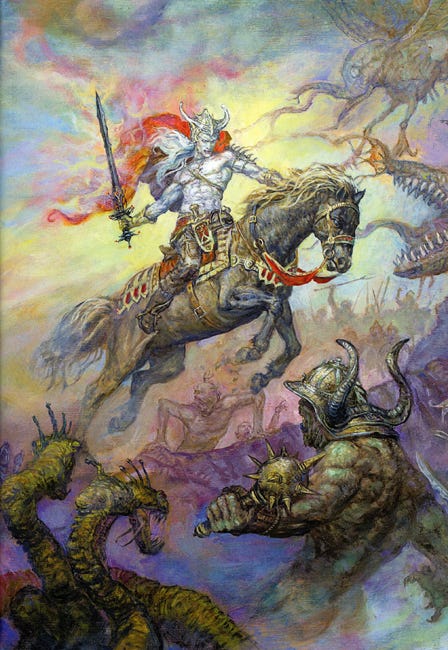
The death of Lord Gho was a sweet just desserts and a good bit of irony. After an entire book of Elric attempting to resist Stormbringer, he finally gave in and rained hell on the city. This was a good break of character; one that will feels like it will haunt him for years to come (whether it actually does remains to be seen, but probably not considering the chaotic publication order of these tales).
In sum
Once again, I’m a bit disappointed in some ways. But I’m also thrilled and pumped in others. Perhaps I will learn to love Elric the way so many others do. Until then, Moorcock keeps convincing me to read on and try to understand.
The Fortress of the Pearl had dope concepts and fun set pieces, and a fantastic beginning and ending that carried the middle slump. I’m excited to see how Elric’s adventure rounds out and how it’s been handled in the 21st century with the newest novel and Moorcock’s contribution to New Edge Sword and Sorcery.
What’s your favorite Elric tale? What am I missing from my readings? Let me know in the comments!
Leave a Reply