When I learned that Jason M Waltz’s final anthology Neither Beg Nor Yield featured a Sword & Sorcery tale penned by Steven Erikson, I don’t think I’ve ever hit Amazon’s “Buy Now” button faster. Erikson is a formative author for me; his Malazan series proved to me that Fantasy is an infinitely rewarding and worthy pursuit. His vivid, mythic writing illustrated the vast horizons awaiting writers if they simply put their back into it.
Fast forward several years, enter my newfound obsession for S&S, my processing of the differences between High Fantasy (my first love) and Heroic Fantasy (what has begun to define my career). Surrounded by short stories, I’d think back to Erikson’s ten book epic, how different it was from everything else I was now absorbing. I know it’s a bit silly, but part of me began to morn this distance from my all-time favorite with my current fixation. For whatever reason, I felt the need to reconcile those differences.
Then, as I was preparing to join Rogues in the House Podcast as a new cohost, I came upon an episode featuring Waltz, Erikson, and C.L. Werner talking Neither Beg Nor Yield. Erikson spoke of R.E. Howard, and the massive influence those seminal works of S&S had on his own. I began to recall the short-fiction techniques used to craft the 3-million-word Book of the Fallen, a previous interview where Erikson talked on “The God in the Bowl,” one of the first Conan tales I’ve ever read—which went on to inform much of my first book, Ashen Rider.
All this preamble is to say that Erikson and Sword & Sorcery are not only compatible, but entirely interconnected. The Epic Fantasy guise of Malazan is only a mask to appeal to the wide world, but at it’s heart, these stories embody the attitude of Sword & Sorcery.
Erikson’s contribution to NBNY, “The Last Vandals on Earth”, is perhaps the first time his writing has been openly marketed as Sword & Sorcery. While it is quite different from the typical S&S story, it is a bloody tale packed with forward momentum (and attitude!), following a dwindling band of Vandals on their desperate flight across the desert of North Africa. It’s witty and a tad high brow, yet it features a heroine who—following with the tradition of heroic fantasy—is an unstoppable force of nature.
I love this tale. I couldn’t take my eyes off it. So I found it troubling that the only accounts of it I found on online were either neutral or downright hateful (accept for one guy on Reddit, who sees it like I do—you rock, sir).
I’ve come this morning to prove them wrong.
The Friction and Why It Works
In my mostly-negative review of Jirel of Joiry, I began with aspects of the text that I liked and which worked well. This time, I’ll take a story I love and begin with the aspects that might turn readers off—and I’ll argue that these elements make the story a stronger in the context of Sword and Sorcery.
In the introductory note, the author explains that this tale is a fictionalized retelling of Sic Gloria Vandalorum (roughly, “thus ends the glory of the Vandals”), Nadir Chapter; a manuscript discovered within an archival trove of ancient documents at an early Christian church in Libya. Understanding this approach to the narrative is essential for understanding the story as it’s presented in NBNY.
“The Last Vandals on Earth” is built around a dying narrator who has taken it upon himself to tell the story of his dying people; thus it is written in the first person epistolary and dives deep into historical context and specifics. These are unconventional choices for S&S, but not unheard of.
Chronicling a First Person Narrative
Some might buck against the use of first person in S&S, but there are excellent works which thrive on it.
Lin Carter’s dual short stories “The People of the Dragon” and “Pillars of Hell” (reprinted in DMR’s Renegade Swords) are both written in first person, resembling oral retellings of epic events that defined the tribe throughout their history.
Michael Shea’s “The Pearls of the Vampire Queen” (reprinted in Battleborn Magazine Issue 1) also takes on a first-person epistolary narrative in the form of Nifft the Lean regaling his pen pal of his adventures by post.
I hesitate to mention my own work in the same breath; Ashen Rider makes heavy use of the epistolary form by way of a dream wizard’s journaled recounting of his visions, which are essential scenes of the plot.
“The Last Vandals on Earth” is written as one man’s chronicle of his people and of Respendial, a mythic hero that carries the spirit of the Vandals into history. Ulfilas is a soldier and cook, as well as a deep thinker. He understands his people’s history and expresses it with proper Vandal vulgarity.
I think maybe we were already done, dragged down by the generations behind us, all those times when we took to the field because our backs were to the wall. Arming everyone who could hold a knife, a spear, even a damned rock. Toddlers wielding axes, newborn babies grasping a teat in one hand and a knife in the other. Do you not wonder why we gave up graves and started cremating our dead?
Erikson, 365.
One might argue that a simple cook would not rattle off the names of kings and cultures, both dead and thriving. I would point to the 24-year-old dishwasher at your local diner; ask him his opinions on student loans and immigration—I guarantee you he will wax political for hours if you let him, regardless if he has a B.S. Political Science or dropped out of high school.
It’s not a strange thing for lay people to have strong opinions on events larger than them—that in-of-itself doesn’t make them correct, nor does it make their perspectives unworthy of examination through narrative.
Ulfilas’s musings on Justinian I, King Gelimer, the duality of Christianity and Paganism, and the various conquests and falls of the Vandals around the world are not strange thoughts for a person whose life is fighting for that very cause.
Admittedly, it all comes off at first as very high brow, like you would have to be an expert on that historical period to even begin to understand this final tale of the Vandals… but that’s never how Erikson’s worldbuilding has functioned.
Mythic Worldbuilding
In most Sword and Sorcery, worldbuilding is not the draw. It’s usually off the cuff and presented only to the serve the plot. This does not mean that worlds remain unbuilt until the story is being written.
Howard’s Hyborean Age was an elaborate worldbuilding project with an entire fictional essay outlining every detail of the peoples, conflicts, and places of the time. Yet Howard drips these details into the fiction as they’re needed, and usually in a way that people just coming into the Hyborean Age wouldn’t necessarily understand on the first read.
Erikson’s own Malazan Book of the Fallen is often touted as the “Dark Souls of Fantasy Literature”, presenting the reader with a massive world and refusing to explain anything outright. It relies solely on subtext and context, as if it was written by a historian of the Malazan Empire for readers who live within the Malazan Empire.
This is a very interesting and effective way to worldbuild that puts characters and narrative on the forefront, unlike the Sanderson approach, which is usually centered around the strange mechanics of the world.
This is exactly the approach Erikson takes with “The Last Vandals on Earth.” What difference is there between fantasy lore you’ve never been exposed to and real-world history you’ve never been exposed to? Is it more acceptable to praddle off the name of Emperor Uriel Septim than it is to talk of Justinian I as if his rule had direct consequences on your people?

You don’t know what you don’t know—and a world rife with things we don’t know if the stuff of Fantasy and Myth. It’s very cool when we can understand every historical reference an author like Erikson packs into his historical fantasy, but not understanding is what generates the whimsy and mystery behind mythic storytelling.
In Flame and Crimson: A History of Sword-and-Sorcery, Brian Murphy argues that much of pulp Fantasy is derived from the Icelandic Sagas, the narrative patterns of Norse Mythology. In his dying hours, Ulias has certainly attempted to craft the myth of Vandals and to forge the legacy of his legendary wife, Respendial.
Respendial, Avatar of the Vandals
Most Sword & Sorcery tales concern the actions of one character, sometimes two. The hero’s actions and overcoming challenges is usually the point of the plot. But not always.
Respendial embodies the archetype of the pulp heroine as a force of nature. She carries the legacy of the Vandals on her shoulders and is said by the witch/goddess of the oasis to be of a unique kind, not to seen again for three thousand years. On her own, she is the like to a protagonist of an Epic Fantasy, which is many ways opposite Sword & Sorcery.
Enter the mediocre husband, Ulias the Little Wolf. A soldier by necessity, a cook by vocation. Through his wide eyes, we see and interpret the actions and triumphs of Respendial.
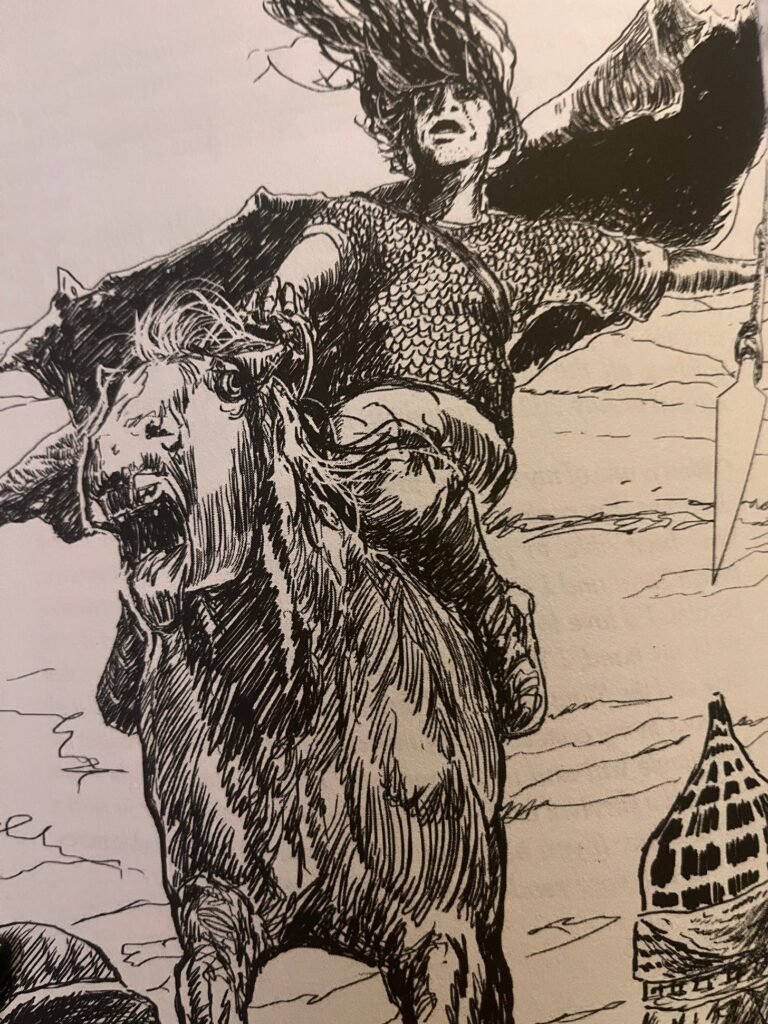
The most detailed action scene in the story consists of Respendial charging three mounted warriors joined by few more foot soldiers. Ulias did not see the exchange, but heard the men’s warcries and deathknells, then witnessed his wife returning triumphant. The action scene itself is what Ulias thought might have happened based on what he knows about mounted combat, horses, and lances. There is no difference to the reader by way of experience—we still get a visceral, bloody fight scene that rocked.
Being that Ulias is the one chronicling the this last journey of the Vandals, the world is filtered through his view and biases, as well as his foreknowledge. It takes the tale of Respendial off the Epic pedestal and throws it rolling in the mud with the rest of us plebeians.
One negative reviewer lamented the limited page time Respeendial was given; which would be understandable if this tale were about Respendial. But Respendial is not the focus of “The Last Vandals on Earth”—the Vandals are. Respendial, instead of being a traditional mercenary-motivated S&S character, is the avatar of the Vandals, the mantle on which their memory rests and propagates through time.
All this culminates into a tale that embodies the mythic wonder of Howard’s writing, and attacks the obligatory conventions of Sword & Sorcery in fresh, unique way that is grounded in history and elevated by a lowly, opinionated perspective.
In Sum
“The Last Vandals on Earth” fucking rocks. I may be an unreasonably enthusiastic Steven Erikson fan, but so too am I for Sword & Sorcery. This tale takes the genre and rearranges its parts in wild and bloody angles. It is focused more on experience and the communication of legacy than plot, which consequently makes for swift and easy-to-follow plot that was joy to read.
What I love most about Sword & Sorcery is its predictability; as reader you almost always know what you’re going to get. At the same time, this can get stale. Every now and then we need someone to throw a wrench in our routines and force us out of our comfort zone.
Do yourself a favor—purchase Neither Beg Nor Yield and read this tale. If you don’t like it, fine; you’ll still have one of the best S&S anthologies on the market.
Leave a Reply