Last week I discussed the ups and downs of my experience reading Jirel of Joiry by C.L. Moore, which are the five original tales of the first female Sword & Sorcery protagonist. While there was a lot I enjoyed about Moore’s classics, there were equally as many points of friction, which made for a tumultuous read.
I’m pleased to inform you that Molly Tanzer has remedied every issue that I took with Moore’s originals in her upcoming book, Blue Fire, the first officially licensed novella-length tale of Joiry’s Lady.
Tanzer is a seasoned novelist, perhaps best known for her 2015 debut Weird Western novel, Vermilion, and her Victorian Supernatural Romance series, The Diabolist’s Library. She first took up the mantle of Joiry in New Edge Sword & Sorcery Issue 3, with “Jirel and the Mirror of Truth” which had quickly become a fan favorite. Tanzer reprised Jirel in NESS Issue 5, with a third tale upcoming in NESS’s 2026 run.
So it should come as a surprise to no one that Blue Fire is absolute fire (Am I hip yet?). Running now on BackerKit, the novella is kicking ass and taking names, and will be available to back until July 4th.
I had the pleasure to read an Advanced Reader’s Copy. While I was provided a free ARC by the publisher, Brackenbury Books, that has no bearing on this review. This review is not sponsored and the publisher does not know the content of this review until it hits the public. Below are my unbiased thoughts.
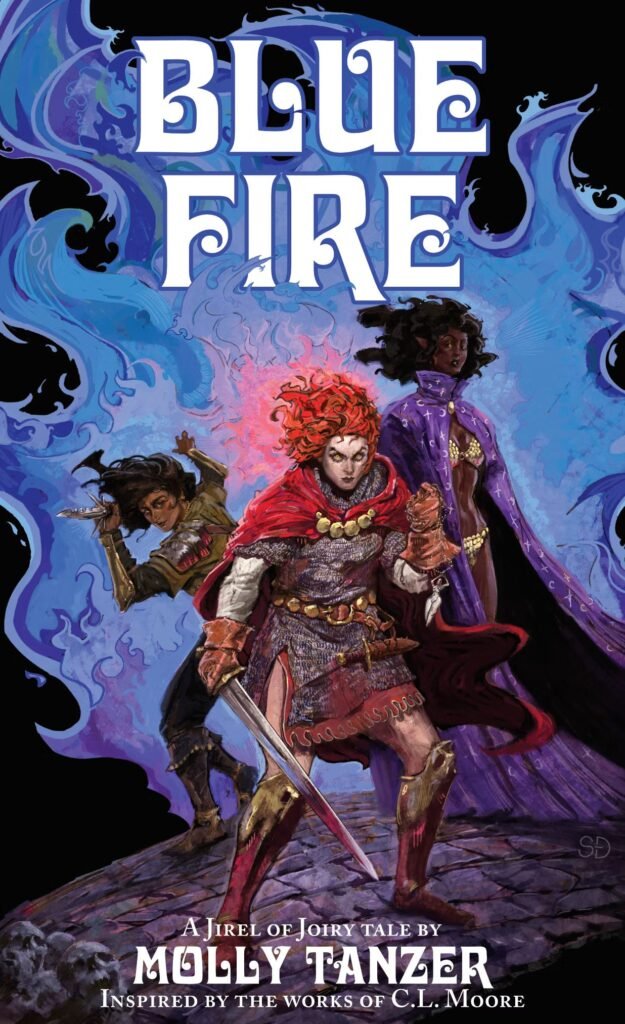
Jirel in Action
My biggest gripe with the original Jirel of Joiry stories was that Moore spends a disproportionate time in Jirel’s head, so the reader rarely got to witness her strength as a warrior or a commander.
Tanzer maintains much of Moore’s lyrical interiority but does so with a modern sense of brevity and clarity, while lacing several instances of Jirel in action. Finally, the Lady of Joiry is given her sword and allowed to cut down those who stand in her way.
In terms of violence, the only time Moore’s Jirel kills another human being is when she’s breaking out of captivity in “Hellsgarde.” She gets a lot more opportunity to show off her sword play in Blue Fire.
There are fun set pieces and inventive battles with monstrous baddies. At the same time, she’s dealing with a mysterious curse that imposes a sorcerous illness upon her, keeping with Moore’s structural requirement that Jirel be debilitated in some way. I felt this was a much better use of that trope than simply disarming Jirel at every possible opportunity.
As much as I enjoyed these encounters, the fantastic elements present verge on Heroic High Fantasy rather than Sword & Sorcery with its whimsical world building and accessible magics. I think this is a good fit for Jirel, given her penchant for planeswalking into strange worlds. The story is bright and light-hearted in many ways, which I think will make it appeal much to younger readers as a stepping stone into the pulp classics.
Stories like this are a welcome addition to our modern understanding of S&S, as far as I’m concerned.
A Loner No Longer
Jirel (in)famously leaves behind Father Gervase to explore hellish worlds and other planes in the classic stories. A brilliant spice that Tanzer added to the Jirel recipe was friendship. We actually get to see Jirel’s connection with Gervase before she abandons him.
There’s also the return of Thevin Galois from Tanzer’s NESS short, “Jirel and the Mirror of Truth,” who acts as a supporting warrior companion, who introduces some interesting complications that drive the story forward. I appreciated Thevin’s presentation—she is a mess and has a host of her own problems, a constant engine of conflict and progressive complications. Tanzer has told me that Thevin can sometimes threaten to overtake the protagonist’s throne in the drafting process. In Blue Fire, I recognize this trait in Thevin’s writing, but it works in favor of the narrative when Jirel inevitable finds herself alone again, despite all the chaos surrounding Thevin, which acts to drive Jirel’s plot forward.
Without diving too deep into spoiler zone, Blue Fire’s Jirel does have a classic hike through Hell itself. This closing stretch of the book is where the novella most closely resembles something that Moore would have written. The whole conflict of the tale is centered on plot elements set up in the classic tale, “The Dark Land,” and pays them off wonderfully by the end.
Is Blue Fire Faithful to the Originals?
Absolutely. I think existing Jirel fans will appreciate Tanzer’s modern approach to Moore’s storytelling and how she injects her own style into it. Tanzer maintains many of the recognizable recurring elements from the classics (such as Jirel’s doeskin tunic) and reprises unique turns of phrase.
For the most part, the prose and the dialogue maintains a timeless element. Blue Fire could have been published long ago. But not always; sometimes, especially in dialogue involving Thevin, the narration verges upon modern phrasing.
I mentioned earlier that Blue Fire embodies more elements of High Fantasy, which is a deviation from Moore’s classic tendency toward the Weird. This might bother some fans of the classics, but I think it’s the natural progression of Jirel. High Fantasy is a good fit for this type of traditional Fantasy heroine who often visits other worlds.
Perhaps what Jirel gained in her abilities as an action hero diminished some of the strange horror of Moore’s classic. There’s a tradeoff for everything. What Tanzer did maintain was Jirel’s interiority, which is a hallmark of the originals. Jirel remains deeply thoughtful, and incredibly unwise.
Tanzer’s depiction of Jirel as a person and ruling knight of Joiry is also incredibly faithful to Moore’s depiction. Jirel retains her nearly self-flagellant Catholic faith, she is fiery, short-sighted, and impulsive. She is Jirel, in every way possible.
In Sum
I enjoyed the hell out of Blue Fire. It’s a truly refreshing take on a classic character that I think will please existing C.L. Moore fans and convince younger readers that Pulp Fantasy is worth a deep dive.
In leans more into High Fantasy than the conventions of Sword & Sorcery, but it remains an excellent Heroic tale that prominently features both Swords and Sorcery with swift pacing and interesting dilemmas.
It’s a worth read, for certain. You can back the campaign on BackerKit until July 4th.
Leave a Reply