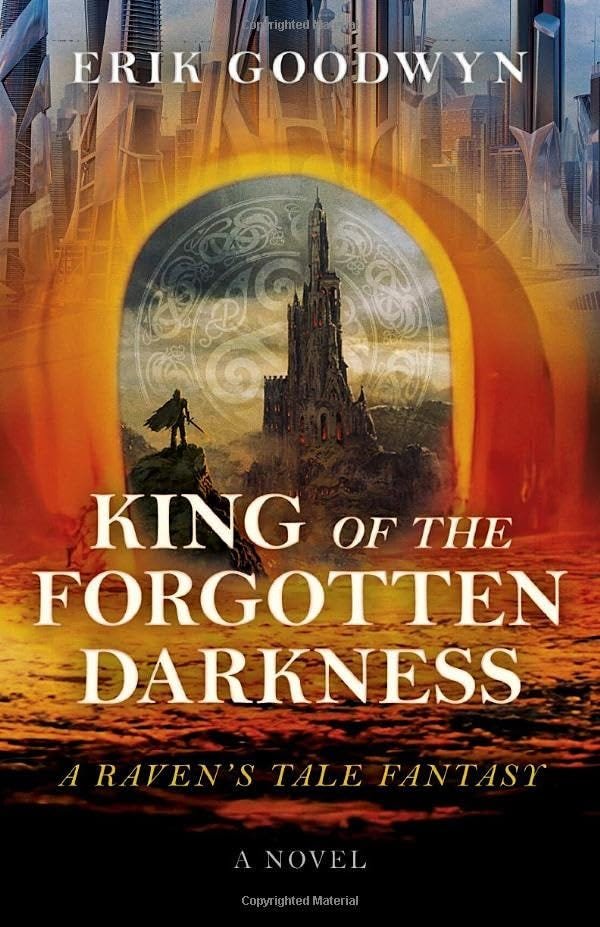
Young Adult Fantasy (or New Adult) is often disparaged by the broader Fantasy books community, and much of that criticism is well-founded. YA Dark Fantasy, King of the Forgotten Darkness by Erik Goodwyn, does not fall into the those common pitfalls—it’s a modern myth, at once thoughtful, easy to absorb, and so incredibly relatable.
Dr. Erik Goodwyn, among many other things, is a psychiatrist with more than 20 years’ experience and a prominent scholar of Carl Jung. Goodwyn seamlessly integrates his expertise of Jungian archetypes, mythology (and how these things meld and manifest internally in our dreams, externally in our Fantasy fiction) into his Fantasy.
You can read this book for surface level enjoyment, and you’ll have a great time. Soo too can you read in deeper and see a plethora of intentional mythological and psychological stitches woven into the broader narrative. You could hand this book to your 13-year-old son and be confident he’ll fall in love with the world of Erentyr and come away better for it.
This is one that will remain on my shelf for my kids to find—it’s a formative tale that can reinforce a developing mind, providing safe examples of trauma and transcendence with real-world analogues; all-too-essential for developing the anti-fragility of a young mind, which is tested less and less in today’s world of convenience and instant gratification.
See my full talk with Erik Goodwyn on YouTube.
A World of Dreams
While the beginning of this tale takes place in the near-future Midworld (which illustrates a disturbing logical conclusion of our current AI-obsessed society), it soon transitions into the fairy tale realm of Erentyr.
This is a portal fantasy—something I’m usually not a fan of—but that portal is one of the most important elements to the myth. Erentyr is dreamlike (at least, those in Midworld would have you believe that it’s the “fake” world), and when we fall asleep we undergo a process that constructs our dreams, which is very similar to the concept of a portal. When estranged lovers, Liam and Mia, step through the portal to Erentyr, they undergo a sort of translation/transformation from the mundane world to the Fantasy world.
Erentyr acts as an externalization of Liam’s traumas and Mia’s issues with neglect, which embodies one of the core strengths of Fantasy fiction—externally illustrating the internal. Every obstacle and strange creature they encounter is some way an extension of their struggles.
(BTW, my habit of writing with emdashes is symptom of being a Mac user and not of AI interference. This obsession of mine long predates Claude.)
Isolation to Reunion
Without diving too far into the plot, Liam and Mia comprise our main two POVs that we hear from throughout the book. Liam is relatable, but ultimately I found Mia’s arc the most compelling. Together, they illustrate how the issues of the modern materialistic world can drive people apart, but overcoming hardship in a brutal, primal reality can bring people together.
They have arguments that ring far too close to home, digging into relationship struggles we’ve all faced. Mia begins meek and codependent, and eventually takes a dark-yet-independent turn as she explores her Erentyr-given sorcerous talent. Liam has bottled up and suppressed his traumas borne of a violent childhood and has to learn to navigate emotional release, maturity, and forgiveness. Though they are experiencing a Fantastic journey externally, internally they are going through things most folks are/have, too.
Because they come into the Fantasy world of Erentyr from the near-future Midworld, they speak and think in modern terms (which does wear away some as they spend more time with the people of Erentyr’s), they act as perfect avatars for a young to reader to see the world from, to consider hard questions. Again, this is something I’m not usually a fan of in Fantasy, but it serves the greater narrative so well, the book would not be the same without it.
I must hammer in the notion of this book’s importance for young readers. The author has placed every aspect of this book with intention to engage the mind of a teenager, to relate with them, and meet them where they’re at in our current year which is far too similar to the dystopian Midworld of KOTFD’s first 50 pages.
Much of the interpersonal conflict could have been written from my own life—I’ve never seen such relatability in Fantasy.
The Friction (For Me)
My critiques of Goodwyn’s debut in Fantasy fiction are largely up to personal preference. I’ve already discussed my feelings against portal fantasies and modern dialogue in Fantasy; I also praise Goodwyn’s use of both elements here, as they lift up the tale rather than detract from it.
Because this book is written with younger readers in mind, often subtext is used sparingly. Rather than spending a paragraph describing the feeling of rage, the narrator will state the Liam or Mia is enraged, which can sometimes come off as blunt. Yet it is another choice I can’t help but stand by—because of this, KOTFD is an easy read and accessible to anyone interested in reading it. Even with Erentyr’s vast depth, you can splash around on the surface if all you want is a whimsical Dark Fairy Tale before bed.
I do wish we spent less time in Midworld, which comprises the first six chapters. When I picked up this book, I came specifically for Erentyr and the hook of “a jungian psychiatrist wrote a dreamlike fantasy,” and what a hook it is! The story really opens up once it gets to Erentyr; Goodwyn’s nature writing is superb and he’s clearly spent much time studying highland culture (after writing my original Goodreads review, he wrote me and confirmed that he’s spent much time traveling in Ireland and Scotland).
In Sum
KOTFD closes with a classic happy ending where the heroes prevail over the darkness. I think this is a wonderfully refreshing narrative choice and in tune with the shifts in modern culture.
Dark, cynical, hopeless tales are fading away because the real world is dark, cynical, and hopeless. This is a dark tale, but full of whimsy, victory, growth, sincerity, and incredibly believable characters and relationships.
Liam and Mia, being former lovers, often bicker and each time it happens, I’m struck by how real those moments are. I’ve been there, I’ve had that argument. Somehow, they learn how to move forward, rather than burning yet another bridge, another skill lacking in our current society.
It’s been some time since I put down this book, and I continuously think back on it with growing fondness. I can’t wait to share it with my kids one day, and I’m very excited to dive into the next chapter of Erentyr.
Leave a Reply