The Lady of Joiry is a fiery character, both in her wild mane and her short temper. She is also an incredibly unique addition to the First Wave of Sword and & Sorcery as the genre’s first published heroine. With Conan’s debut in Weird Tales with “The Phoenix on the Sword” in 1932, it’s only natural that Jirel should tear up the pages shortly after in 1934 with “Black God’s Kiss.”
Though Moore’s first step into our beloved genre was likely heavily inspired by Howard, through their correspondence by post, Moore and Howard mutually inspired one another. This led to Howard’s interpretation of heroic female protagonists in Red Sonja and Dark Agnes. H.P. Lovecraft was also known to just gush about Moore’s prose in their letters.
You can read more about those pen pal relationships in Phillip Royce Johnson’s article I ran on Arcanist Online.
There’s no denying C.L. Moore’s status among the greats of pulp fiction. Her prose is vivid and momentous and dreamy. Beyond the five original Jirel stories, she was a prolific author creating several revolutionary works of Science Fiction, which is what she most famous for… but that’s not what we’re here to discuss.
We’re here to hone in on Jirel of Joiry—the five tales which inspired countless other Fantasy authors to walk in Moore’s footsteps. As cool as I think Jirel (the character) is and as brilliant Moore’s prose can be… I struggled with these stories.
In hindsight, I’m not sure I even liked them.
The Good and the Beautiful
Before I get into the grime of shitting on one of the most beloved S&S characters, I want to pay respects to what worked. I am not claiming that these are in any way poorly written tales, they just weren’t for me for many reasons I’ll soon get into.
The plot of every one of the stories was genuinely interesting, inspired, and incredibly weird. There was a recognizable formula that worked very well: Jirel is (usually) challenged by a male villain, often someone who she was romantically involved with or someone who was interested in her. The villain threatens her autonomy and presents a supernatural challenge that prevents Jirel from simply cutting her way to victory. Despite being rather unwise, Jirel comes to a clever, spontaneous solution to destroy this villain and maintain her autonomy as the Lady of Joiry.
You are always rooting for Jirel—and always captivated by the obstacles before her. Even as we approach a century after these stories’ publication, nothing about them felt cliche, or silly, or retroactively overdone. I genuinely loved “Black God’s Kiss” and “The Dark Land,” and found a good deal to enjoy about “Hellsgarde.”
There were times I was awestruck by the sentences. Moore is at home painting a picture in your brain, and not in the immediate way how I would seek to write a description. Moore’s prose is ephemeral and ethereal, set entirely apart even from more purple pulp writers like Clark Ashton Smith.
But this very beauty of articulation quickly gets long winded, and it’s what gets in the way of Moore’s expression of Sword & Sorcery, a genre which thrives by getting to the point.
The Long Wind
I do not envy whomever has taken it upon themselves to narrate the audiobook for Jirel of Joiry. With the Penguin Random House collection on the horizon, I know some poor poor bastard has volunteered as tribute (2012 called, James…).
I’m not sure if it was just the eBook version I was reading, but “Black God’s Kiss” set me up for a well-organized run through a vivid hell. It had competent scene breaks and excellent pacing, and one of the most compelling and innocent yet sinister hooks I’ve ever read.
Then we get into its direct sequel, “Black God’s Shadow,” which is a rehashing of Kiss’s plot… but so much worse.
Scene breaks be damned, we enter a hellscape montage of Jirel running and slashing and thinking and lamenting for pages and pages and pages. Every sentence was a beauty, but as a whole, it made my head swim.
This was the point in the book I began to think if I was just missing something. Perhaps if Moore had cut down this tale by 1/3, I might not have felt this way. Maybe I was just too sleepy—I was reading it at night in bed, after all.
I was so relieved when Shadow finally ended. I jumped back to page one to tackle “Jirel Meets Magic”, and my hope began to fade. This one had a very strong beginning, Jirel busting down a wizard’s door with an army at her back, pissed as all hell. But it soon fell into the same ethereal swill once she passed the gateway into an other world (which is also a common plot element, and one I think hurts the tales, more on that in a bit).
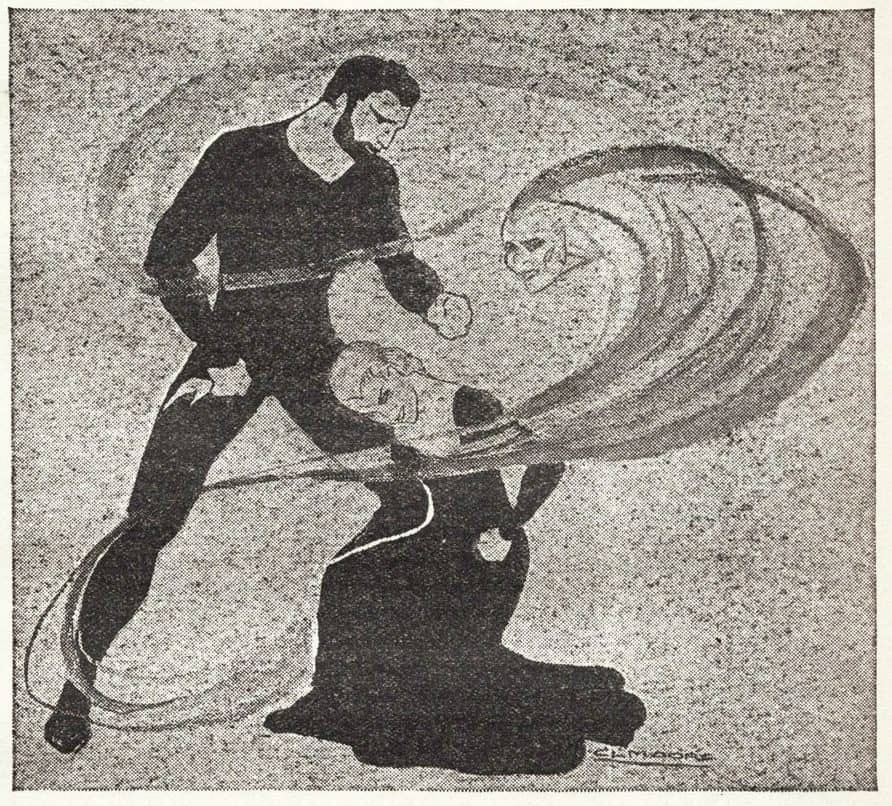
By the time we came around to “The Dark Land,” I think I had grown accustomed to Moore’s writing. I definitely had more fun dealing with Pav, and Jirel’s psychedelic adventure in Romne and looking back, this one was my favorite of the bunch. It even had a great twist! But I had resigned myself to getting lost throughout the text—I stopped trying to stay present.
“Hellsgarde” was much the same for me. It was interesting with a good plot, but it just kept going. Moore spends a lot of words describing Jirel’s feelings. It goes beyond interiority and is more like reading someone else’s thoughts entirely. Not a journal, mind you, but pure stream of consciousness. It’s neat, but it’s not what I’m looking for in Sword & Sorcery and rarely what I want out of Fantasy.
What I’m looking for is a strong, decisive character who gets dragged through the mud and kicks ass anyway. What Moore gave us a character she claimed was strong, but never really embodied a warrior’s strength.
I Wanted to See Joiry
When Jirel pursues Giraud through the portal in his castle courtyard, she first hands off her longsword to her housecarl and delves into an unknown magical world armed only with her dagger.
I’m sorry, what? What kind of warrior-hero-knight-queen would go alone into an unknown without her sword? Why did she make this decision? The text tells the reader it’s because the sword was too heavy; it wasn’t too heavy when she delved into Hell itself! I’m telling you it’s because the author needed Jirel to be powered down—she’s always disarmed or debilitated in some way.
The text will wax about Jirel’s practical tactical genius (sorry, it’s been too long since I squeezed in a Hamilton joke), but beyond the beginning of “Jirel Meets Magic” we never see her commanding a troupe of soldiers or ruling her people. Further, it’s hard to believe her cunning on the battlefield; she’s constantly being duped into falling into demonic plots beyond her ken.
Her home, Joiry, is a large part of her identity. She is Joiry’s Lady—a leader, ruler, commander. She is Joiry and Joiry is she, a concept cleverly mirrored by Pav and the world of his own creation, Romne. But all we see of Joiry is its dark halls before she goes off alone to explore Hell. The collection should be called Jirel the Planeswalker (new Universes Beyond?) because Joiry is naught else but a backstory and a starting point meant only to be left behind.
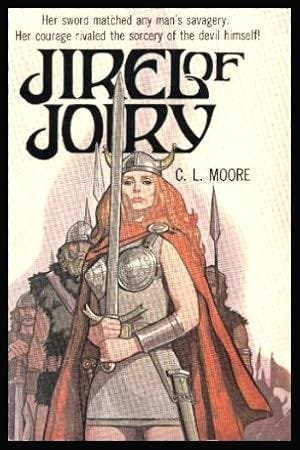
When I saw the cover that I shared above—Jirel in armor, brandishing her blade and standing tall before a host of men—and having no prior knowledge of these stories, I thought I might get a retelling of Queen Boudica raising an army of raucous Celts and leading them to battle to liberate Joiry from Roman invaders.
What we have is a foolish, headstrong woman getting in over her head with supernatural forces and somehow prevailing against all odds. Which is still a cool story… but it wasn’t I hoped for. I want to spend time in Joiry. I want to know why Jirel’s namesake is so important.
In Sum
While I struggled with these stories, understanding them has only helped me understand many other types of Sword & Sorcery that are being written today. C.L. Moore’s ethereal, internal prose has given me permission to let go of my penchent for immediacy in my own writing and spend some time gazing at the flowers and lamenting a loss.
I’ve since read some other tales that pay homage to Moore’s eclectic style, and I loved them. Knowing the inspirations has helped facilitate that love. But I don’t Moore’s specific expression of S&S was solved in the 1930s. I wish she had spent more time in the genre—perhaps a novella length Jirel tale might assuage some of my frustrations…
Wink wink.
Leave a Reply