In a previous review, I claimed that the two dollar eBook is the modern pulp and Titan Books has taken this to heart with the Heroic Legends Series. They’re putting the Robert E. Howard license to work every month with a new novelette-length eBook following a classic Howard character. These are widely available and cost a mere $1.99 with stories penned by authors like Stephen Graham Jones (Conan: Lord of the Mount), Michael A. Stackpole (Belit: Bone Whispers), and many more recognizable names.
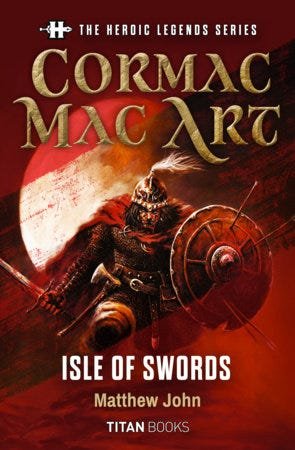
The most recent release, “Isle of Swords” by Matthew John marked the return of Cormac Mac Art, Howard’s Gaelic warrior who fights alongside Danish Vikings. Admittedly, this was my first encounter with Cormac, so I’m approaching this tale without any disillusions of nostalgia.
However, this is not my first run with John’s Sword and Sorcery. To Walk on Worlds was the first novel-length Sword and Sorcery collection I picked up in 2026 and it remains one of my favorite reads of the year. John’s prose is tight and concise, his imagination vast.
Everything that makes The Maxus Cycle great is on full display in Isle of Swords, albeit grounded in Howard’s weird historical world.
Oh hey! If you love S&S, check out my BackerKit for Mordschlag Sword and Sorcery Magazines.
Brotherhood and the Heroic Duo
Popularized primarily by Fritz Leiber’s Fafhrd and the Gray Mouser stories, the heroic duo is a classic iteration upon the Sword and Sorcery protagonist. This tale primarily follows Cormac after a shipwreck, but he is quickly joined by his Dane companion, Wulfhere the Skullsplitter.
John has been praised for his stellar depictions of masculine characters and interactions. Isle of Swords is an example of this quality at its prime. It’s a subtle touch, but the cooperation, trust, and brotherhood between Cormac and Wulfhere is an essential element to a tale like this. They don’t lose their boastful viking spirits, but neither are they falling into the trappings of egotistical competition and domination.
Upon revisiting Howard’s Red Nails, I’ve reflected that Conan is likely so popular among male readers due to his temperance, experience, capability, and prowess—in other words, Conan represents a mythic ideal that readers should strive toward.
John does this, too, with an updated take on the ideal. He illustrates a cooperative partnership between warriors which the modern, isolated reader sorely misses. Lasting friends are harder to come by than ever, these days. Where Howard’s Conan is often diminishing his companions (something we’re more likely to encounter), John’s Cormac and Wulfhere embolden one another.
Cormac and Wulfhere prowling an island for Roman gold and getting into bloody sword fights with hostile Picts makes for a simple action tale on the surface. So too does it provide a briny gale of fresh air at a deeper, primal level.
Frankly, we need tales like this to paint a new mythic ideal of cooperation. To provide an example of true loyalty in the face of overwhelming dangers, of prowess and potential even when we may feel at our lowest. In our dark world, admirable characters give us hope.
Muddy, Bloody Action
Alfred’s axe snapped against the black stone; a crack of lightning lit the scene. The force lifted him from his feet, hammered him backward, into his chieftain. As they crashed to the earth, blades flashed and warcries blared.
John’s economical use of verbs and restrained brevity makes the action in his fiction sing. The reader is never lost, always captivated. The excerpt above engages the senses and yet bears no bells nor whistles, just solid use of language.
We get solid historical details, as well, tactics and brief images of arms and armors, but these things never drench the text and are placed only to enhance the tone. The fights are brutal and messy, bearing all of the danger you’d expect from a historically-grounded dark Fantasy.
A hiss cut the air. Wulfhere grunted. A feathered shaft bristled from his shoulder.
Lines like this paint a vivid picture while using little white space. It’s subtle and evocative, and elegantly says-without-saying “Wulfhere got shot.”
In Sum
There’s little else that I can say for this tale over than to go read it. Even without any prior knowledge of Cormac Mac Art (and some other non-Conan Howard references), I immensely enjoyed short stay with this novelette. Fans of Viking fiction, historical fiction, or classic Sword & Sorcery will find everything they’re after.
It’s right up my alley and it’s firing on all cylinders. A perfect storm. For $1.99 across most eBook platforms, this one is a helluva deal. You can grab it most easily on Kindle.
Leave a Reply