I’m not sure I’ve ever been so challenged by such a short book. Grave’s Daughters by S.E. Lindberg is a dark sky ignited by a thousand flares. Following themes of legacy, raising children in our own image, watching those children’s images morph into something wholly their own… all wrapped in a Weird Dark Fantasy package with an unmistakeable the Dyscrasia identity.
Grave’s Daughters is the fourth book of Lindberg’s long-running Dysrasia Fiction series. Though it is my first (published) encounter with the series. Right off the bat, Lindberg does a lot of work to ensure that new readers aren’t overwhelmed by all the stuff they might have missed. This served as an excellent on-boarding experience and has made me want to turn back and visit Lord of Dyscrasia (2011) for the first time.
The story of Doktor Grave’s three golem daughters is presented as a fix-up novel, with most of the compiled stories previous published by a variety of publications familiar to fans of Third Wave Sword & Sorcery. This approach is largely what makes this book’s on-boarding so effective—any given chapter (aside from the final chapter, serving as a climax) might be your first run in with Dyscrasia.
That said, having read another (yet unpublished) Dyscrasia story, I am amazed at the depth Lindberg achieves with his rather restrained world-building. Returning readers are given all sorts of meat to chew on; yet new readers never feel left out. The short-story chapters serve the pacing well, and keep pages turning.
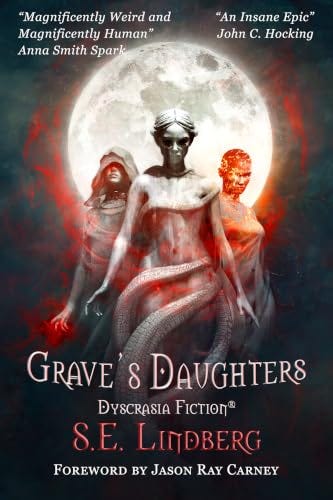
Grave’s Daughters is available in most places where books are sold, but I’ve been told Lulu is the author preferred storefront.
Potent Concoctions. A Singular World.
Just as the book begins with necromancer, nurse, and ancient golem, Doktor Grave mixing strange, sorcerous ingredients into a kiln (which may be the core of the earth?) to bring about his greatest creation yet (three godlike golem daughters), so too is the world of Dycrasia crafted.
Modern Fantasy usually needs a blend of two unique ideas to blend into something new and fresh. Lindberg has melded three:
Pottery and Clay + Chemistry and Medicinal Alchemy + Insectile Horror = Dyscrasia’s World.
As I’ve read, I was consistently marveled at how these seemingly unrelated elements congealed into a singular, interconnected network. There truly isn’t anything like it out there and I’m seriously yearning for a video game or TTRPG set in this strange world.
In most S&S-adjacent Weird Fiction, worldbuilding takes a backseat. In Dyscrasia, the world is completely interwoven into the narrative-structure. The land is one with the characters, and the characters are reliant on speculative physical laws on which the land operates.
With most of the characters being non-human, I’d never want to wake up near the City of Tonn, I’ll tell ya hwhat!
Side note: I love the artifacts. There’s several ancient weapons with names, powers, and heavy reputations. It’s a very fun aspect to include in a such a heavy story.
Bone Chilling Horror Hits Close to Home
This story is not for the faint of heart. At times, it got to me. Beyond my yearly romp with a Stephen King novel, I’m not much of a horror reader, but I’d argue that Grave’s Daughters packs some of the most effective horror that I’ve ever read.
I mentioned the themes of legacy, carrying on a bloodline of a dying race. Doktor Grave (I think) is the last Golem of his kind, and he miraculously creates his three daughters after centuries of failed attempts to procreate.
As time wears on, this responsibility of carrying on the artificial golem race gets passed onto the grown daughters, and it’s presented with a blatantly non-human worldview. The way the golems and other non-human entities discuss procreation is almost how I’d imagine bees discussing it in their hives if they could. It’s a necessity—and it’s not personal nor private.
With everything being so interconnected, we often get a view into how ant-human hybrids would function.
A story like this—by its very nature—treads a thin line. Lindberg is an expert at treading the line, and never crossing it, writing always with masterful tact. His horror disturbs and perplexes, but never repels the reader, instead inviting them to consider the strangeness of Dyscrasia’s world and see it through to its conclusion.
What results is a macabre beauty; a dirty, almost desecrated look at what he hold sacred—and how universal truths like love for one’s children can transcend even the human sphere.
In short, Dyscrasia does what all good horror should seek to do: place a simple topic under a microscope, morph it into something unrecognizable, then highlight the commonalities which remain.
Conflict of Godlike Children
Without diving too far into the plot, I admire the character-work in the three daughters: Leech, Ember, and Melanie. As children, they are almost identical with small differences in their characters only subtilely apparent.
As they grow, their unique powers manifest and so do their Olympian personalities. Their very presence in the mortal causes conflict and complications, and what began as tiny differences in character turn into massive, cataclysmic rifts.
Though every one of them gets a spotlight at least once, I do wish we saw more of Leech and the Orchard-folk. Ember and Melanie’s conflict takes center stage around the midway point.
Each daughter in some way represents the three elements I proposed that make up the core of Dyscrasia—each one is flawed and short-sighted and angry, manifesting those flaws in their own ways, reaping their own consequences.
The titular Grave’s Daughters act constantly to drive forward narrative momentum and the core themes.
Weird Fiction with a Universal Theme
Doktor Grave states the central thesis of the book several times and it hits home throughout: “You must sacrifice one family to join another.”
This refers to several aspects of being both a child and a parent. On one end, Lindberg comments on the necessity of leaving behind one’s parents to become a parent yourself. As I transition into fatherhood myself, this one hits hard.
Another manifestation is that this responsibility of sacrifice gets passed on. Children are protected from the responsibility of sacrifice for a time, then adulthood and growing power thrust responsibility unto the child as they claim their adult independence.
Every action Grave takes is aimed at preserving his children. Every action he takes also brings him closer to agonizing death.
In Sum
This was a challenging read and much outside my wheelhouse… and holy cow, am I glad I took the dive into this strange world. I recommend this to readers who yearn for something strange, alien, and captivating and to those who prefer heavy doses of horror splashed into their Dark Fantasy stew.
I will certainly return to the prior three books in my unending TBR rotation. And I greatly look forward to reading Lindberg’s next foray into the ant-tunnels beneath the decayed earth.
Leave a Reply