What is a hero? What is a villain? These questions are addressed—though not answered—by Scott Oden’s excellent 2022 novelette Xenia in the Court of the Winds. Frankly, I was blown away by this tale. It’s a perfect blend of classical myth, creative subversion, and inventive narration.
EDIT: I’ve been informed that this novelette is also printed of a larger multi-author work from 2017 called A Sea of Sorrow. Very cool, but unfortunately it seems it’s out of print.
This is the sort of story I feel was written for me. Obviously not me, personally, but I am the certainly part of the intended audience and have subsequently become a huge Oden fan.
At times I felt Xenia was too smart for me; akin to feeling I got reading an article from a peer reviewed accounting journal during my MBA. Only instead of the hopeless dread of trying to interpret the endless (and context-void) acronyms of the hardcore business world, I was delightfully challenged to stretch my brain and learn something new about Ancient Greece (a rare novelty, indeed!)
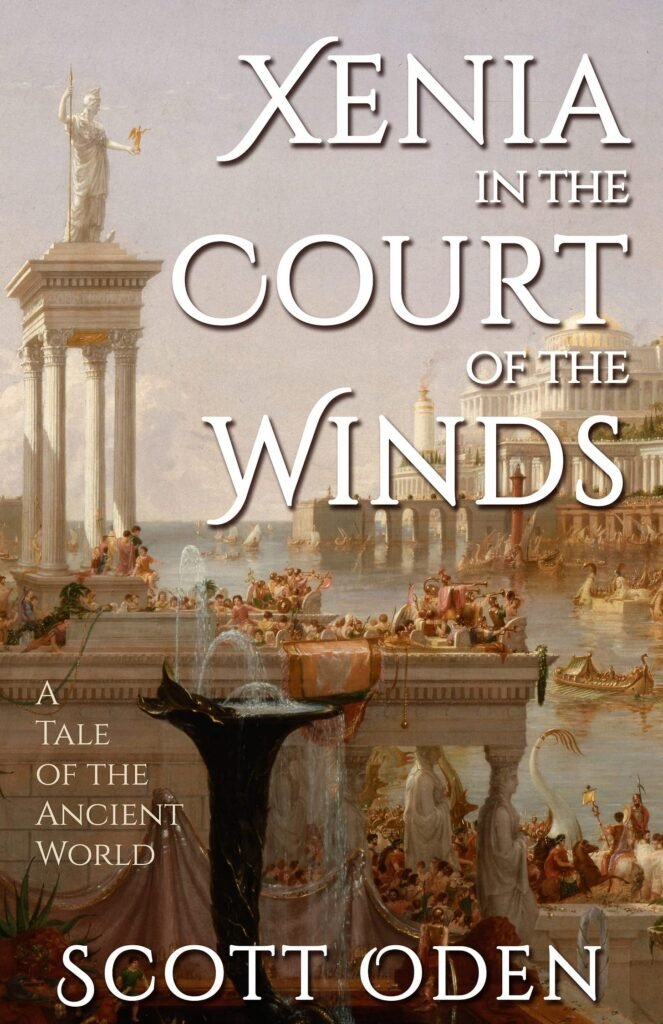
Xenia in the Court of the Winds is available as PDF/EPUB on Scott Oden’s Ko-Fi shop.
Monsters Wearing the Skin of Man
According to Homer, Polyphemus was a monstrous cyclops which Odysseus blinded to escape horrific death in the depths of a coastal cavern. Oden presents a different monster, not a mythic beast, but a one-eyed hermit who refuses to engage in Xenia, the divine laws of hospitality.
“What is that, dear Eirene? You do not know this word, xenia? Come, the sun has stolen our shade. Let us shift to that seat, yonder, beneath your father’s stately oak tree. Yes, this is much better. Xenia, child, is the duty one man owes to another: that he offer the hospitality of his oikos, his household, to a stranger in need. You welcome the stranger, offer them food and drink and a bath; you give up your comforts for them – your favorite chair or most comfortable bolster – and make them a gift upon their departure.” Oden, 10
After a battered Achaean arrives at Polyphemus’s doorstep, demanding he hand over fresh butcher flanks from his (and even the guy’s wife), Polyphemus instead gave him a spear to the heart. What followed was slaughter at the hands of Odysseus and Co.
Much of this tale concerns Polyphemus presenting his case to King Aeolus in the Court of the Winds, seeking to recompense and to dispense warning of the villainous Odyssus. Who was in the right? Were they both in the wrong?
With diegetic tact, Oden cleanly explains the cultural norms the narrative hinges on, flips them on their head, and cross-examines them. Better yet, he gives the reader space to consider the arguments from the lens of the boy acting as our narrator and guide in the ancient world.
Playing with Narration
In my own writing, narration is one of my favorite devices to play with. It’s often overlooked and underutilized, with most authors playing it safe with third-person or first-person POV that fade into the background. For most this is a good choice, but I appreciate authors who take the leap into stranger waters.
In Xenia, our narrator is an old man named Glaukos telling the tale (to his grandson Eirene) of Polyphemus’s arrival in Aeolia when Glaukos was a boy.
There are many layers to this deployment of narration:
- Retrospection of the narrator’s youth
- Consideration of the youthful recipient
- A child’s perspective of mythic events
- Unreliably memory and biases of the narrator
- Emulation of pre-literacy spoken tradition
It is bold and risky, and pays off wonderfully—though it may take some time for some to get their bearings with it. I could have easily read a novel-length work with this narrator.
In Sum
Xenia in the Court of the Winds takes familiar subject matter and examines it closely, experimenting the whole way with presentation. It takes the familiar and makes the reader question their preconceived notions.
Truly a masterful work of modern myth and worth your time and money for a $5 eBook. I already have two more Oden books on my soon TBR.
Leave a Reply