Typically I prefer my Sword & Sorcery to be grounded in reality, to exhibit a gritty realism so that the reader is unsure whether the protagonist can actually prevail. Then I read Thongor and the Wizard of Lemuria (review here), which convinced me to chill out and revel in the strange.
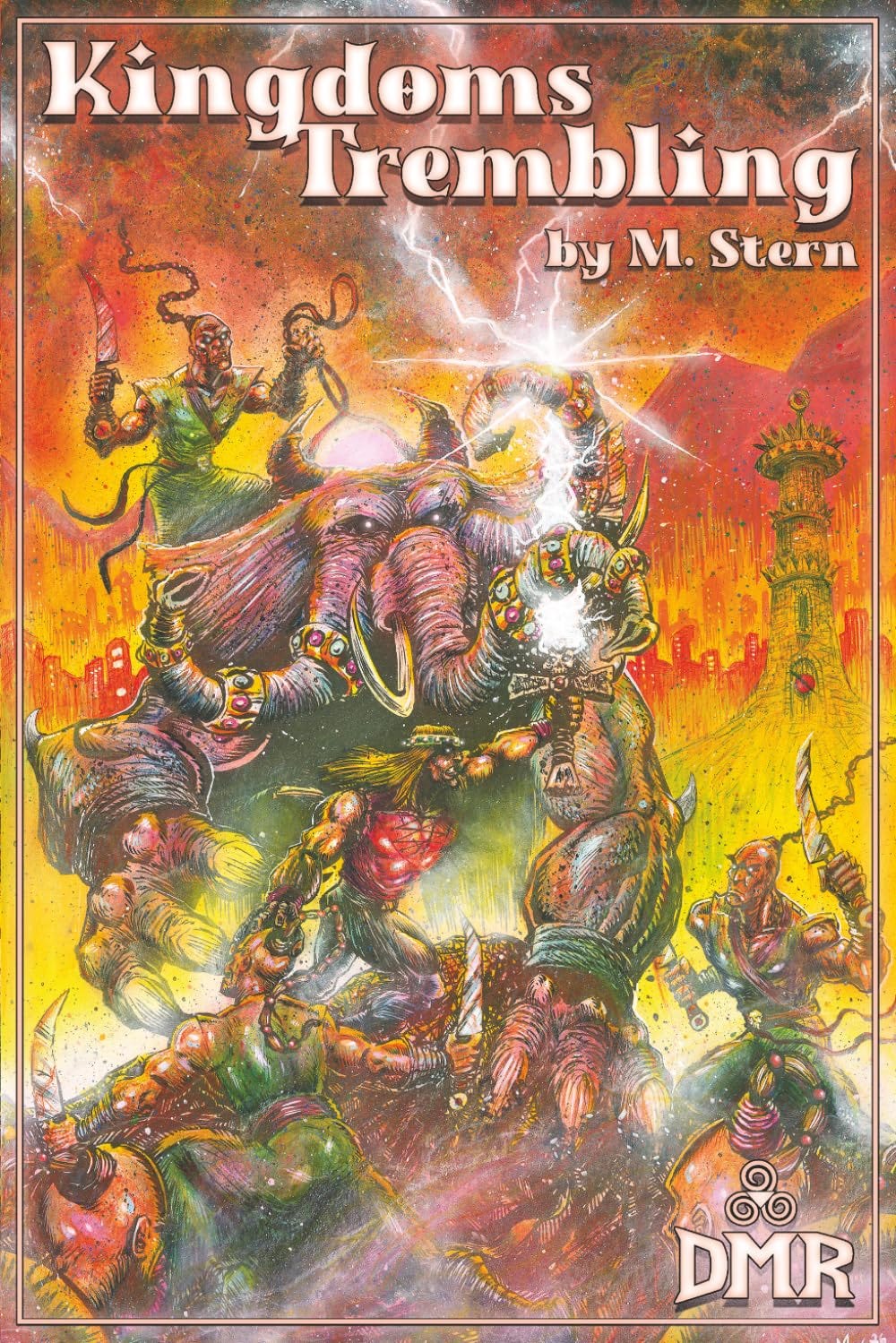
I was provided an advanced reader’s copy of Kingdoms Trembling by M. Stern, which might not have been something I picked up a few months ago—but holy hell am I glad I came across it now.
Stern takes the weirdness and cosmic horror that often accompanies Sword & Sorcery and turns it up to eleven. At the same time, Stern maintains a grounded believability within the context of the Kingdom of Kingdoms, K’Zal, placing the reader firmly into the boots its strange peoples who are not so unlike us.
Kingdoms Trembling reads like an artifact of another world, written for readers of that world… and that’s my absolute favorite approach to worldbuilding, and one of the methods I think works best for the genre.
Hey! If you love Sword & Sorcery, please consider following my upcoming BackerKit Campaign for Mordschlag Sword and Sorcery Magazine!
Masterful Structure and Composition
Stern’s eye for simply arranging stories into a coherent fixup novel is next level. Though Kingdom’s Trembling rarely returns to previously established characters, every subsequent tale builds upon themes and narrative elements of previous entries.
For example, in one story a character encounters a strange, teleporting creature called a Devok, which allow people to ride on their thick asses (my own interpretation, lol) to teleport to distant lands. This encounters get a bit into the intricacies behind socializing with these fickle creatures, then moves on. The very next tale dives deep into Devoks, as they become integral to plot for that entry.
A highlight across the entire work is the opening vignette “The Passion of Young Osivrain in The Bright Season,” which establishes a sincerely romantic tone contrasted and contradicted by nearly everything else that follows in the text.
He laughed at himself and reached for her hand and she took it.
“One day I will travel far from this yot. One day I will be known in K’Zal, the Kingdom of Kingdoms. For what, I cannot say! But for something! And I believe you will join me, my dear. I believe we shall together be great.”
Stern 6.
Though it’s only one page, I love this introduction; it immediately tells the reader why Stern’s writing stands apart from so many others. Even though we’re about to embark on a bloody, psychedelic journey through harsh, sand-geyser-riddled deserts where even the smallest, most innocuous insect can melt the flesh from your bones, there is a joyful optimism laced throughout the text.
Just because the world is messed up doesn’t mean it isn’t beautiful.
Without diving too deep (you should read it for yourself), the romanticism established in this first page rears its handsome head at several intervals throughout the book and pays off beautifully by the end.
Sometimes the headers themselves take artistic liberties. “Fyrox Finds a Vengeful Path After Surviving the Storming of Aksoot” begins with a free form poem and is the only story to do so. “Osivrain and Yoen Pursue Raiders to Tayo’or” has subsection titles, but the third is just the traditional roman number III, as that was the most apt descriptor.
These diversions from a standard form are intentionally placed to remind the reader to relax and get freaky with it.
A Strange and Familiar World
Another standout with Stern’s Sword & Sorcery is his approach to worldbuilding. In most other S&S tales I’ve read, worldbuilding takes a backseat or isn’t really present at all. Stern immerses the reader in K’Zal, throwing out strange terms and customs, almost akin to the Inter-dimensional Cable shows of Rick and Morty. This approach holds this work upon a set of knobby legs, and Kingdoms Trembling would not work without it.
A bard wearing a loincloth and horned silver mask, body dyed with pigments of the royal color fade, sand in a deep, throaty warble while plucking out a tune on the luutne. A few toga-clad women reclined on plush cushions, one stroking a small, furry oongaboos, its eyes bulging, another feeding boldok meat to a visiting royal cousin.
Stern, 212
This scene reads unmistakably Athenian, riddled with hints of decadence and debauchery. Though I couldn’t tell you how one plays a luutne, or what the hell a oongaboos or boldok is, Stern’s care for linguistic principals gives the reader just enough to work with to create a mental image.
One might make the argument that Stern’s world borders on High Fantasy, and perhaps some elements straddle that line, but it’s the unique approach to plot and character that cements this work as an excellent piece of the Sword & Sorcery lexicon.
Where High Fantasy would spent time explaining things to the reader, Kingdoms Trembling builds atmosphere. The titles of the each of the included 12 stories are themselves an integral building block to the atmosphere, acting as historical descriptions of uncanny happenings throughout the storied fall of K’Zal (which is not depicted in this book, only foreshadowed, hence the trembling).
Blood and Attitude
Most of the protagonists we meet are warriors or cunning men of action. Every one stands alone and takes on a new flavor of the S&S attitude. The opening to “Tsogxot Brings Art to the Autarchy of Dolorox” is a clear example of this in action:
“I am no foreigner, though I have spent many cycles abroad! I am called Tsogxot. I was raised here by my father, my mother having died in childbith.”
“Tsogxot?” the man said, getting closer. He was shirtless, wearing farmer’s pants, sand-caked black boots, sword in hand. “This name. How many cycles have you?”
“I have twenty-eight cycles, and left at seventeen, when the Will of the Sand took my father,” Tsogxot said. “What is it to you?”
“Apostate!” the man cried. He raised his sword and charged.
Stern, 188-189
Other types of stories might have seen Tsogxot enter his hometown peacefully, but under watch, or perhaps imprisoned. Instead, Tsogxot paints a woman’s dress red with his attacker’s blood and marvels at his handiwork.
Another example is toward the beginning in “Fyrox Finds a Vengeful Path After Surviving the Storming of Askoot,” when Fyrox is taken by his sorcerous illness and his body mindlessly seizes, swinging his sword while he’s having a quiet moment with a tavern woman he fancies. Fyrox’s status as an outsider S&S protagonist prevents him from living a normal life throughout the tale.
My One Critique
Though I love this book and wish I could write several more paragraphs analyzing its strengths, it would not be review without a pain point. For me, the friction was singular—the lack of overt characterization.
I’ve already said the Kingdoms Trembling’s protagonists were unique and stood out from one another despite their similar roles as men of action—and that’s true!—but all that work is done with subtext and subtlety.
These things are the markings of a master, but in a world with names like Koerthyq and Pektelemum I often found myself losing track of minor characters. I feel a bit more in the way of simple physical characteristics could have assuaged this.
At its most coarse, this problem appeared in “Weaponmaker Roxatoi Becomes Sidetracked Returning to Lotzactol” (an otherwise excellent tale), where Roxatoi encounters a gang of men escorting a young girl with an uncanny secret. I realized halfway through the story that there were three men with the girl, when I had thought there were only two.
I just can’t connect identities to alien names without something more tangible to hold onto. This isn’t as challenging with names constructed more recognizable linguistic patterns (like Aurodeomus and K’Zal itself).
In Sum
Kingdoms Trembling is an excellent read and breath of fresh air for folks looking for something different. It’s a masterclass performance of composition and imagination, and one of the few books I’ve decided to shelf for a second read later on.
It cherishes its Sword & Sorcery blood, but isn’t afraid to branch out to serve the immersion. There isn’t a weak story in the contents.
It’s available from DMR and on Amazon. Give it your attention.
Leave a Reply